#
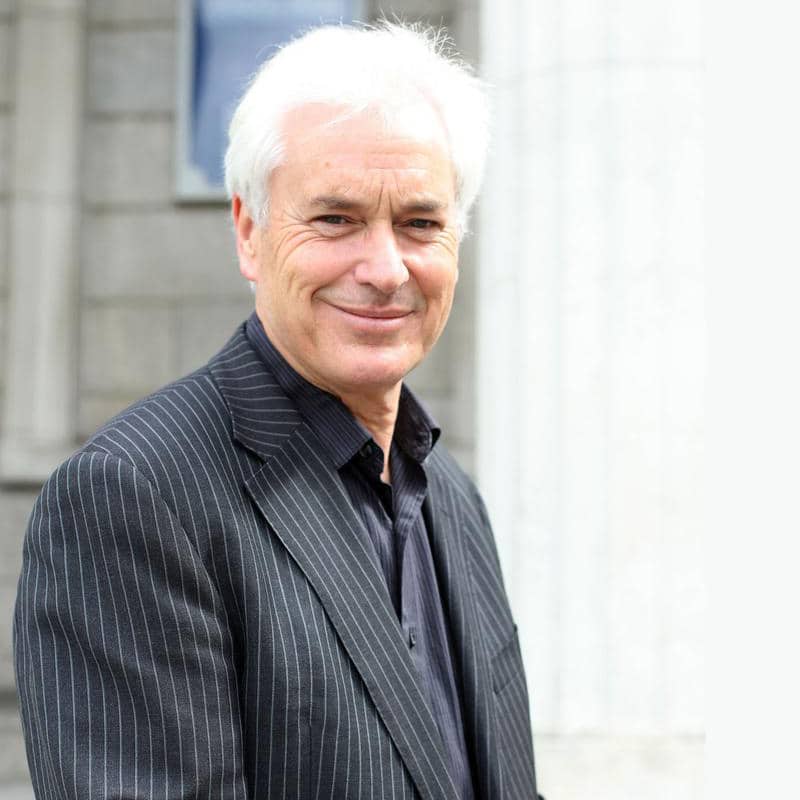
Dr Ian Robertson is a clinical psychologist and neuroscientist. He is the Founding Director of the Trinity College Institute of Neuroscience, a Professor of Psychology at Trinity and Co-Director of the Global Brain Health Institute. Previously, he was a Senior Scientist at the MRC Cognition and Brain Sciences Unit at the University of Cambridge.
Robertson is a leading expert on stress and wellbeing, having published over 250 scientific articles in journals and has written several books on the mind, exploring stress, confidence and power. His latest book focuses on the science behind confidence.
This podcast is in two parts released this week and next. Today he talks to us about fascinating topics like “the Winner Effect” and “The Loser Effect”, how to breed success in the brain and different types of power and how these can affect our behaviours if we’re not aware of them.
Summary
(02:26) Moved into brain research
Worked for ten years as a practising clinical psychologist
There was a disconnect between the mind and brain
Set up a research program at the MRC Cognition and Brain Sciences Unit at the University of Cambridge
(04:28) What is the theory of ‘the Winner Effect’?
Landau’s chicken hierarchy
There was further proof from the green sunfish experiment (1967) and tennis players (2013)
“It’s a primitive biological fact that winning gives you more of a chance of winning the next contest”
(07:13) How does success breeding success happen in the brain?
Winning brings a surge in testosterone, which increases dopamine in the brain’s reward network
Dopamine lifts your mood, lowers anxiety, and increases motivation and aggression
Depending on the level of dopamine, it can make you smarter
Too much dopamine causes a lot of the problems that we see in dictators
(08:32) The ‘Loser Effect’
All mammals form dominance hierarchies
The lower you are in a hierarchy, the lower your dopamine levels, which makes you less likely to take action
This can be seen in positron emission tomography (PET) scanners
(10:07) Advice to children and teenagers playing in competitive sports
You should play to enjoy, not to win
Training children to always win gives them a comparative mindset, which makes them more vulnerable to threats
Make your own metric of success and focus on intrinsic motivation
Teach children to learn from their mistakes
(15:25) The potential consequences of power and behaviour
Power is one of the greatest brain-changing agents
Bertrand Russell likens power in human relations to energy in physics
Power narrows your attention
Too much power for too long can turn into a quasi-addictive cycle
If a person has too much power, they lose empathy for others, become blind to risk, show misjudgements and become greedy and critical
(18:50) Constraining power for the greater good
One of the reasons why we succeed as a species is because we work in groups
External governing constraints like democracy and freedom of press are designed to constrain power
In the corporate world, there is a lot of focus on financial auditing but not power auditing
Having clear values helps with an individual’s internal constraints
(23:17) The need for more women in leadership positions
Women have more S-power – i.e. more focused on goals for an institution, a group or a society – than N-power, which is focused on personal goals
In the West, a woman’s self-concept is more embedded in their relations and a man’s self-concept is in themself
Women are naturally better collaborators and team players than men
Women help increase the IQs of small groups
We need both men and women in leadership roles
(26:50) The effect of being an introvert vs. extrovert when it comes to power
Extroverts are more dominant in groups
There is space for both personalities
(28:19) The addictiveness of power
Addiction to power is like being addicted to drugs
Power makes you seek more power, e.g. money
The ego is the biggest challenge to overcome the addiction to power
A person’s ego swells when they are in power and become more hyper-sensitive to threats
Through practising meditation and mindfulness, you learn that the ego is just an illusion
(40:22) Managing our minds and emotions
“Confidence is the most valuable resource a human being can have”
Confidence leads to action
Anxiety is the opposite of confidence, and it makes you do less things
Follow the podcast
The 1% Podcast brings together the 3Ps of People, Professions and Performance. We chat to top-class performers from eclectic areas (sport, business, politics, art etc.) to extract the tactics, tools and routines you can use to get 1% better and achieve success.
" height="24px" id="v04r379mL" transform="translate(2 0)" width="19.536000000000005px"/></svg>)
" height="23.999264284236244px" id="ghOdDMk_v" transform="translate(0.001 0)" width="24.000264254861435px"/></svg>)