Purpose & Philosophy

Finding Purpose: Lessons from a Murmuration
Jonny Cooper

Director of Leadership Development
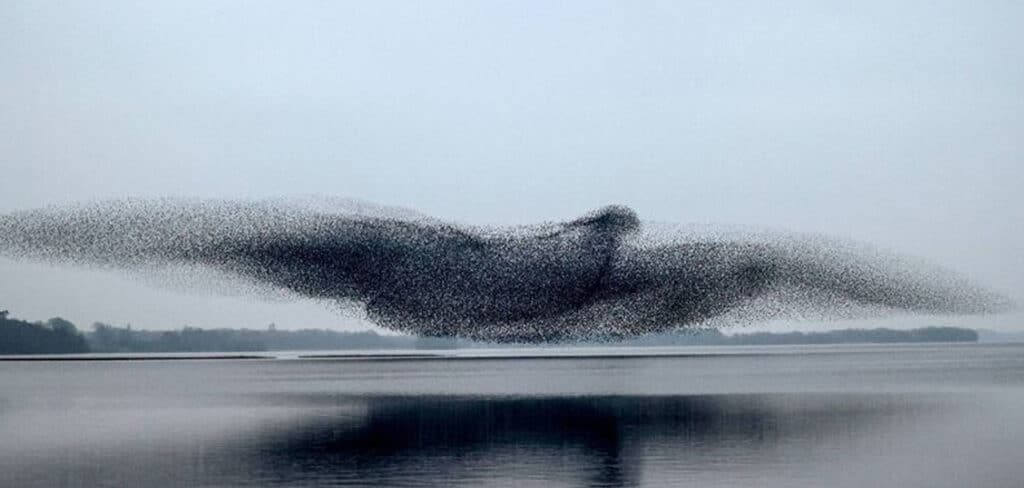
In the natural world, few phenomena are as mesmerizing as a murmuration of starlings. Thousands of birds move in perfect unison, creating breathtaking patterns in the sky. What makes this display so captivating is not just its beauty but the silent choreography that guides it. Each bird knows its role, intuitively following a shared purpose—a survival instinct that protects them from predators, ensures their safety, and sustains their collective harmony. This metaphor offers profound insights into the human journey of finding purpose. Just as a murmuration is driven by a “why” that unites the flock, our purpose becomes the inner compass that directs our actions and aligns us with something greater than ourselves. Here are three key parallels between the murmuration and the human quest for purpose.

1. Clarity Fuels Alignment

In a murmuration, every bird doesn’t act independently or chaotically. Each starling is deeply attuned to its neighbours, making micro-adjustments in response to the collective flow. This synchronicity arises because of a shared, instinctual understanding of their purpose: to survive and thrive together. Similarly, when we discover our “why,” it becomes easier to align our actions with our values and goals. Purpose acts as a filter for decisions, helping us move cohesively toward what matters most. Without this clarity, we risk veering off course, much like a murmuration would dissolve without its guiding instinct.

2. Purpose Magnifies Impact

Individually, a single starling is vulnerable, but together, their movements create a force that confounds predators and inspires awe. In the same way, when individuals come together around a shared purpose, their impact is exponentially greater than the sum of their parts. Purpose provides a sense of belonging and interdependence, reminding us that our contributions matter most when they are part of a greater whole—whether that’s a community, an organisation, or a family.

For humans, this speaks to the importance of not only finding personal purpose but also connecting it to a collective one. Much like starlings find safety and strength in numbers, we too find resilience and fulfilment when we pursue goals that align with a larger vision.

3. Adaptability Requires a Clear Why

In a murmuration, the starlings’ movements are not rigid or predetermined. Instead, they adapt fluidly to changes in their environment—whether dodging a predator or shifting direction with the wind. Their shared purpose provides a foundation for this adaptability, enabling them to respond to challenges without losing cohesion. For us, purpose plays a similar role, offering stability amid uncertainty. When life throws obstacles our way, a clear sense of purpose helps us remain grounded and adaptable, guiding us through change with intention rather than fear.

Conclusion: The Power of Knowing Your “Why”

The murmuration reminds us that purpose is not just an individual pursuit—it’s a dynamic force that connects us to ourselves, others, and the world around us. When we know our “why,” we move with confidence and grace, no matter the challenges. Like starlings weaving intricate patterns in the sky, our lives take on a deeper beauty and meaning when guided by purpose.

Steering Point partners with organisations, teams, executive leaders, and performers to foster positive behavioural change resulting in sustainable high performance. We specialise in designing experiential engagement programmes that develop cognitive, behavioural, emotional, and leadership capacities.

More on Purpose

Unpacking the Meaning of Work

Unleashing Leadership Excellence with Dan Pontefract – Podcast

Professional Meaning: Why it’s Important and How to Find it

Creating and fostering cultures of meaning

More Like This

Purpose & Philosophy

Schopenhauer and the Workplace

Arthur Shopenhauer was a German philosopher best known for his 1818 treatise The World as Will and Representation, in which he posited, in short, that the world around us does not exist in itself, but is rather only a representation of the way we each subjectively experience it. Any objective reality, such that it exists, can never be witnessed or experienced by humankind due to the subjective nature of consciousness. Writing recently in The Atlantic, Arthur C. Brooks, host of the How to Build a Happy Life podcast, argues that while Schopenhauer’s grand thesis may be what made his name, it is his other, lesser-known works which harbour greater wisdoms that we should each be incorporating into our day-to-day lives, especially if we are on the verge of undertaking a large, daunting project. Brooks says Schopenhaur’s work “offered rules for living that stand up remarkably well when compared with the findings of modern research; they provide what has come, for me, to be the best guidelines for doing the big thing” [1]. By the big thing, Brooks refers to writing a book, running a marathon, learning to play piano, or any other such task that requires endurance and discipline. The core arguments Schopenhauer made that Brooks champions are: embracing mindfulness, thinking of the big picture, living day-by-day, and blocking out external noise. By undertaking these practices, promoted by Schopenhauer in the middle of the 19th century, one can have a better relationship with their work today.

Shay Dalton

Purpose & Philosophy

Professional Meaning: Why it’s Important and How to Find it

It’s not who you are underneath, it’s what you do that defines you. Batman said it so it must be true. (Technically it was said to him first then made a running motif of the film’s core theme, but we may be splitting hairs.) What we do does define us. Look no further than the first question directed your way by any small talk specialist at a party: what do you do? The question has a more pronounced meaning than simply what is your career. It’s designed to get a sense of what that profession says about you – your class, education, status, salary. The most popular surname in Germany and Switzerland is Müller, meaning miller. In Slovakia, it’s Varga, the word for cobbler. In the UK, Australia, New Zealand, Canada and the US, it’s Smith, due to the word’s attachment to a variety of once common trades such as blacksmith and locksmith [1]. Your work, then, used to be your literal identity. In purely nominative terms, that has changed. We do not live amongst Wayne Footballer, Elon Disruptor or Donald Moron. But in terms of social function, our profession is still the definitive modus of identification, at least on first glance. In today’s world, unlike in Batman’s, our job is both what we do and indicative of who we are underneath.

Shay Dalton

Purpose & Philosophy

Unpacking the Meaning of Work

Consider a simple yet profound question: What does your work mean to you? Is it merely a task to be completed, or does it resonate with a deeper purpose in your life? Viktor Frankl, a prominent Austrian psychiatrist and philosopher, grappled with these very questions, evolving them into a broader exploration of life’s meaning. Drawing from his harrowing experiences in Nazi concentration camps, he developed logotherapy—a form of psychotherapy that centres around the search for meaning and purpose. Through logotherapy, Frankl illuminated the idea that life’s essence can be found not just in joyous moments but also in love, work, and our attitude towards inevitable suffering. This pioneering approach underscores personal responsibility and has offered countless individuals a renewed perspective on fulfilment, even in the face of daunting challenges. In this piece, we delve into the intricacies of Frankl’s teachings, exploring the symbiotic relationship he identified between work and our quest for meaning.

Shay Dalton

Purpose & Philosophy

Schopenhauer and the Workplace

Arthur Shopenhauer was a German philosopher best known for his 1818 treatise The World as Will and Representation, in which he posited, in short, that the world around us does not exist in itself, but is rather only a representation of the way we each subjectively experience it. Any objective reality, such that it exists, can never be witnessed or experienced by humankind due to the subjective nature of consciousness. Writing recently in The Atlantic, Arthur C. Brooks, host of the How to Build a Happy Life podcast, argues that while Schopenhauer’s grand thesis may be what made his name, it is his other, lesser-known works which harbour greater wisdoms that we should each be incorporating into our day-to-day lives, especially if we are on the verge of undertaking a large, daunting project. Brooks says Schopenhaur’s work “offered rules for living that stand up remarkably well when compared with the findings of modern research; they provide what has come, for me, to be the best guidelines for doing the big thing” [1]. By the big thing, Brooks refers to writing a book, running a marathon, learning to play piano, or any other such task that requires endurance and discipline. The core arguments Schopenhauer made that Brooks champions are: embracing mindfulness, thinking of the big picture, living day-by-day, and blocking out external noise. By undertaking these practices, promoted by Schopenhauer in the middle of the 19th century, one can have a better relationship with their work today.

Shay Dalton

Purpose & Philosophy

Professional Meaning: Why it’s Important and How to Find it

It’s not who you are underneath, it’s what you do that defines you. Batman said it so it must be true. (Technically it was said to him first then made a running motif of the film’s core theme, but we may be splitting hairs.) What we do does define us. Look no further than the first question directed your way by any small talk specialist at a party: what do you do? The question has a more pronounced meaning than simply what is your career. It’s designed to get a sense of what that profession says about you – your class, education, status, salary. The most popular surname in Germany and Switzerland is Müller, meaning miller. In Slovakia, it’s Varga, the word for cobbler. In the UK, Australia, New Zealand, Canada and the US, it’s Smith, due to the word’s attachment to a variety of once common trades such as blacksmith and locksmith [1]. Your work, then, used to be your literal identity. In purely nominative terms, that has changed. We do not live amongst Wayne Footballer, Elon Disruptor or Donald Moron. But in terms of social function, our profession is still the definitive modus of identification, at least on first glance. In today’s world, unlike in Batman’s, our job is both what we do and indicative of who we are underneath.

Shay Dalton

Purpose & Philosophy

Unpacking the Meaning of Work

Consider a simple yet profound question: What does your work mean to you? Is it merely a task to be completed, or does it resonate with a deeper purpose in your life? Viktor Frankl, a prominent Austrian psychiatrist and philosopher, grappled with these very questions, evolving them into a broader exploration of life’s meaning. Drawing from his harrowing experiences in Nazi concentration camps, he developed logotherapy—a form of psychotherapy that centres around the search for meaning and purpose. Through logotherapy, Frankl illuminated the idea that life’s essence can be found not just in joyous moments but also in love, work, and our attitude towards inevitable suffering. This pioneering approach underscores personal responsibility and has offered countless individuals a renewed perspective on fulfilment, even in the face of daunting challenges. In this piece, we delve into the intricacies of Frankl’s teachings, exploring the symbiotic relationship he identified between work and our quest for meaning.

Shay Dalton

Purpose & Philosophy

Schopenhauer and the Workplace

Arthur Shopenhauer was a German philosopher best known for his 1818 treatise The World as Will and Representation, in which he posited, in short, that the world around us does not exist in itself, but is rather only a representation of the way we each subjectively experience it. Any objective reality, such that it exists, can never be witnessed or experienced by humankind due to the subjective nature of consciousness. Writing recently in The Atlantic, Arthur C. Brooks, host of the How to Build a Happy Life podcast, argues that while Schopenhauer’s grand thesis may be what made his name, it is his other, lesser-known works which harbour greater wisdoms that we should each be incorporating into our day-to-day lives, especially if we are on the verge of undertaking a large, daunting project. Brooks says Schopenhaur’s work “offered rules for living that stand up remarkably well when compared with the findings of modern research; they provide what has come, for me, to be the best guidelines for doing the big thing” [1]. By the big thing, Brooks refers to writing a book, running a marathon, learning to play piano, or any other such task that requires endurance and discipline. The core arguments Schopenhauer made that Brooks champions are: embracing mindfulness, thinking of the big picture, living day-by-day, and blocking out external noise. By undertaking these practices, promoted by Schopenhauer in the middle of the 19th century, one can have a better relationship with their work today.

Shay Dalton

Purpose & Philosophy

Professional Meaning: Why it’s Important and How to Find it

It’s not who you are underneath, it’s what you do that defines you. Batman said it so it must be true. (Technically it was said to him first then made a running motif of the film’s core theme, but we may be splitting hairs.) What we do does define us. Look no further than the first question directed your way by any small talk specialist at a party: what do you do? The question has a more pronounced meaning than simply what is your career. It’s designed to get a sense of what that profession says about you – your class, education, status, salary. The most popular surname in Germany and Switzerland is Müller, meaning miller. In Slovakia, it’s Varga, the word for cobbler. In the UK, Australia, New Zealand, Canada and the US, it’s Smith, due to the word’s attachment to a variety of once common trades such as blacksmith and locksmith [1]. Your work, then, used to be your literal identity. In purely nominative terms, that has changed. We do not live amongst Wayne Footballer, Elon Disruptor or Donald Moron. But in terms of social function, our profession is still the definitive modus of identification, at least on first glance. In today’s world, unlike in Batman’s, our job is both what we do and indicative of who we are underneath.

Shay Dalton

Purpose & Philosophy

Unpacking the Meaning of Work

Consider a simple yet profound question: What does your work mean to you? Is it merely a task to be completed, or does it resonate with a deeper purpose in your life? Viktor Frankl, a prominent Austrian psychiatrist and philosopher, grappled with these very questions, evolving them into a broader exploration of life’s meaning. Drawing from his harrowing experiences in Nazi concentration camps, he developed logotherapy—a form of psychotherapy that centres around the search for meaning and purpose. Through logotherapy, Frankl illuminated the idea that life’s essence can be found not just in joyous moments but also in love, work, and our attitude towards inevitable suffering. This pioneering approach underscores personal responsibility and has offered countless individuals a renewed perspective on fulfilment, even in the face of daunting challenges. In this piece, we delve into the intricacies of Frankl’s teachings, exploring the symbiotic relationship he identified between work and our quest for meaning.

Shay Dalton

Stay Ahead Every Sunday

Every Sunday we compile a digest of the weekend’s business news including the main talking points and highlights from

For information about our privacy practices and commitment to protecting your privacy, check out our Privacy Policy.

Stay Ahead Every Sunday

Every Sunday we compile a digest of the weekend’s business news including the main talking points and highlights from

For information about our privacy practices and commitment to protecting your privacy, check out our Privacy Policy.

Stay Ahead Every Sunday

Every Sunday we compile a digest of the weekend’s business news including the main talking points and highlights from

For information about our privacy practices and commitment to protecting your privacy, check out our Privacy Policy.