Thought Leadership

The Differences Between a Performer and a High Performer

Jonny Cooper

Director of Leadership Development

At its core, performance relies on a combination of awareness, discipline, effort, and openness. Every day, billions of individuals engage in performance, whether it’s in a professional context, in the realm of education, or in their personal lives with friends and family. However, not everyone exhibits the same level of engagement and effectiveness in their performance. Individuals can be categorised into two groups: performers and high performers. Subtle but significant differences separate the two. Performers are characterised by their commitment, leadership ability, and mindfulness. High performers, meanwhile, possess a clearly defined purpose, a unique capacity for creation, and a deep sense of care. The high performer will always delve a layer deeper. They want meaning and understanding, something profound. While not everyone may want to be a high performer, those who do can benefit from some common insights and opportunities.

Common insights

Imagine a triangle, with its broad base representing character and competence. These feed into one’s skill set, then build to a sharp apex at the top: execution. High performers approach each layer systematically and share some common insights:
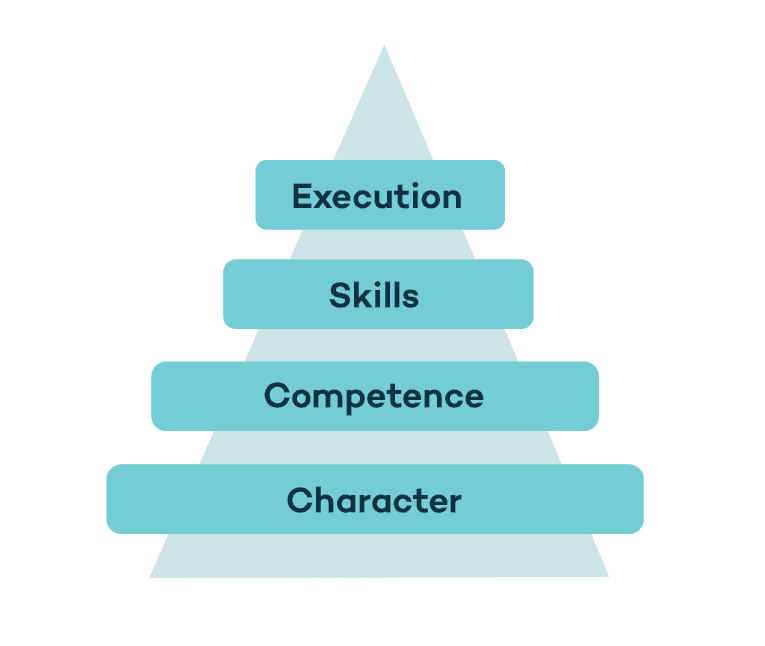
Execution – combined with experience, the accumulation of a high performers character, competence and skill level determines their ability to execute in a moment. They see execution as an opportunity to obtain feedback.

Skills – Often holding a position of a leadership or influence high performers are consistently scanning. They are proactive and eager to refine their current skillset and acquire new and more relevant skills.

Competence – High performers back themselves while striving to produce higher quality. A common trend evident is that they are relentlessly curious in search of new insights to develop their true competence.

Character – At the base there is daily significant growth potential. High performers consistently nurture this space, more often in the shadows. They know that their true quality is always left behind the room they leave.

Key opportunities


In today’s dynamic performance landscape, three key development opportunities stand out:

  1. Why, What and Who
    Understanding why you do what you do, what you aim to achieve, and who can support you is crucial to maximising your potential. These questions serve as a compass for personal growth.

  2. Cultivating Deeper Relationships and Fostering Trust
    Research consistently highlights the centrality of trust in all social interactions. Trust enhances collaboration, encourages vulnerability, improves communication, and fuels idea generation. Deepening your relationships can have far-reaching personal and strategic benefits.

  3. Objective Goal Measurement
    Consider the difference between the 2D roadmaps of the past and the current 3D versions on your phone. Which of them offers greater clarity? Which helps you get where you’re going faster? Clear, detailed goals enhance efficiency. They provide a roadmap that not only guides you but also identifies potential risks, opportunities, timelines, and obstacles to be aware of.

High performance is not always easy to define or achieve, but you know it when you see it. Those who do achieve it will always stand out.


More on Peak Performance

Building Optimal Performance

How to Achieve Peak Performance

More Like This

Thought Leadership

Beating Winter Malaise: Stay Productive During Dark Season

Game of Thrones, and its Song of Ice and Fire source material before it, connected with viewers around the globe for a variety of reasons. Arguably first among them was escapism. For an hour each week, viewers would disconnect from their lives and focus instead on this intoxicating fantasy realm, replete with magic, medieval brutality, and dragons. But even the most seemingly imaginative of otherworldly distractions requires some ties to everyday reality to land with an audience. For Games of Thrones, one such stark (and Stark) pronouncement that permeated the zeitgeist and became an everyday part of the cultural lexicon was the oft-repeated, ever-ominous assertion: Winter is coming. As clocks turn back in most of the western world, we must contend with the fact that, though we are still in the throes of autumn, winter has come, or at the very least is coming, bringing with it the annual productivity malaise that accompanies the season of darkness. Winter is the least productive season for businesses. That’s according to research from project management software company Redbooth, published in Forbes magazine1. The company analysed their data over a four-year period and found that in winter users completed 22.8% of their tasks on average, compared with 27.3% in the autumn, 25.4% in the summer and 24.5% in the spring. A report by British Summer Fruits2 found that during the colder months, 74% of people find it harder to get out of bed for work, while 37% are far more likely to call in sick. In A Christmas Carol, Charles Dickens proclaimed that, “Darkness is cheap.” Not, it seems, if you’re running a business contending with a seasonal productivity slump.

Shay Dalton

Thought Leadership

Charlie Munger: How Psychology Drives Business Success

In the world of investing, Charlie Munger is a legendary figure, celebrated for his sage-like wisdom and insightful aphorisms. As Warren Buffet’s right-hand man, his approach is a testament to the power of effective decision-making and wisdom, which he famously accredits to his ‘multi-disciplinary’ approach—a rich mosaic of insights from various academic disciplines, including applied, organisational, and social psychology. Munger’s perspective is unique and practical because he harnesses these theories and translates them into real-world applications. His approach forms an interesting amalgamation, merging business acumen with psychological theories—a powerful combination that leads to meaningful, insightful, and profitable decisions.

Shay Dalton

Thought Leadership

Beating Winter Malaise: Stay Productive During Dark Season

Game of Thrones, and its Song of Ice and Fire source material before it, connected with viewers around the globe for a variety of reasons. Arguably first among them was escapism. For an hour each week, viewers would disconnect from their lives and focus instead on this intoxicating fantasy realm, replete with magic, medieval brutality, and dragons. But even the most seemingly imaginative of otherworldly distractions requires some ties to everyday reality to land with an audience. For Games of Thrones, one such stark (and Stark) pronouncement that permeated the zeitgeist and became an everyday part of the cultural lexicon was the oft-repeated, ever-ominous assertion: Winter is coming. As clocks turn back in most of the western world, we must contend with the fact that, though we are still in the throes of autumn, winter has come, or at the very least is coming, bringing with it the annual productivity malaise that accompanies the season of darkness. Winter is the least productive season for businesses. That’s according to research from project management software company Redbooth, published in Forbes magazine1. The company analysed their data over a four-year period and found that in winter users completed 22.8% of their tasks on average, compared with 27.3% in the autumn, 25.4% in the summer and 24.5% in the spring. A report by British Summer Fruits2 found that during the colder months, 74% of people find it harder to get out of bed for work, while 37% are far more likely to call in sick. In A Christmas Carol, Charles Dickens proclaimed that, “Darkness is cheap.” Not, it seems, if you’re running a business contending with a seasonal productivity slump.

Shay Dalton

Thought Leadership

Combatting Decision Fatigue

What milk do you want with your coffee? Which song of the millions at your fingertips do you want to start your day? Which of that growing stack of emails are you going to answer first? Choose this. Now that. Are you sure? And again. Choices, choices, decisions, decisions, all day, every day – and aren’t you feeling tired? By some estimates, adults today make 2,000 decisions an hour [1]. By others, 35,000 decisions a day [2]. Either way, it’s an overload. And it’s causing decision fatigue.

Shay Dalton

Thought Leadership

Charlie Munger: How Psychology Drives Business Success

In the world of investing, Charlie Munger is a legendary figure, celebrated for his sage-like wisdom and insightful aphorisms. As Warren Buffet’s right-hand man, his approach is a testament to the power of effective decision-making and wisdom, which he famously accredits to his ‘multi-disciplinary’ approach—a rich mosaic of insights from various academic disciplines, including applied, organisational, and social psychology. Munger’s perspective is unique and practical because he harnesses these theories and translates them into real-world applications. His approach forms an interesting amalgamation, merging business acumen with psychological theories—a powerful combination that leads to meaningful, insightful, and profitable decisions.

Shay Dalton

Thought Leadership

Beating Winter Malaise: Stay Productive During Dark Season

Game of Thrones, and its Song of Ice and Fire source material before it, connected with viewers around the globe for a variety of reasons. Arguably first among them was escapism. For an hour each week, viewers would disconnect from their lives and focus instead on this intoxicating fantasy realm, replete with magic, medieval brutality, and dragons. But even the most seemingly imaginative of otherworldly distractions requires some ties to everyday reality to land with an audience. For Games of Thrones, one such stark (and Stark) pronouncement that permeated the zeitgeist and became an everyday part of the cultural lexicon was the oft-repeated, ever-ominous assertion: Winter is coming. As clocks turn back in most of the western world, we must contend with the fact that, though we are still in the throes of autumn, winter has come, or at the very least is coming, bringing with it the annual productivity malaise that accompanies the season of darkness. Winter is the least productive season for businesses. That’s according to research from project management software company Redbooth, published in Forbes magazine1. The company analysed their data over a four-year period and found that in winter users completed 22.8% of their tasks on average, compared with 27.3% in the autumn, 25.4% in the summer and 24.5% in the spring. A report by British Summer Fruits2 found that during the colder months, 74% of people find it harder to get out of bed for work, while 37% are far more likely to call in sick. In A Christmas Carol, Charles Dickens proclaimed that, “Darkness is cheap.” Not, it seems, if you’re running a business contending with a seasonal productivity slump.

Shay Dalton

Thought Leadership

Combatting Decision Fatigue

What milk do you want with your coffee? Which song of the millions at your fingertips do you want to start your day? Which of that growing stack of emails are you going to answer first? Choose this. Now that. Are you sure? And again. Choices, choices, decisions, decisions, all day, every day – and aren’t you feeling tired? By some estimates, adults today make 2,000 decisions an hour [1]. By others, 35,000 decisions a day [2]. Either way, it’s an overload. And it’s causing decision fatigue.

Shay Dalton

Thought Leadership

Charlie Munger: How Psychology Drives Business Success

In the world of investing, Charlie Munger is a legendary figure, celebrated for his sage-like wisdom and insightful aphorisms. As Warren Buffet’s right-hand man, his approach is a testament to the power of effective decision-making and wisdom, which he famously accredits to his ‘multi-disciplinary’ approach—a rich mosaic of insights from various academic disciplines, including applied, organisational, and social psychology. Munger’s perspective is unique and practical because he harnesses these theories and translates them into real-world applications. His approach forms an interesting amalgamation, merging business acumen with psychological theories—a powerful combination that leads to meaningful, insightful, and profitable decisions.

Shay Dalton

Stay Ahead Every Sunday

Every Sunday we compile a digest of the weekend’s business news including the main talking points and highlights from

For information about our privacy practices and commitment to protecting your privacy, check out our Privacy Policy.

Stay Ahead Every Sunday

Every Sunday we compile a digest of the weekend’s business news including the main talking points and highlights from

For information about our privacy practices and commitment to protecting your privacy, check out our Privacy Policy.

Stay Ahead Every Sunday

Every Sunday we compile a digest of the weekend’s business news including the main talking points and highlights from

For information about our privacy practices and commitment to protecting your privacy, check out our Privacy Policy.