

Thought Leadership

The Myth of ‘Loving the Work you do’

Shay Dalton

Managing Partner

As the age-old saying goes, ‘If you love what you do, you never work a day in your life’. But how true is it? For most people, loving what you do comes at a cost. And loving what you do may not be as fulfilling as you’re led to believe. It is natural for humans to search for meaning in their careers, especially when most of the waking day is spent at work. In fact, the average person spends 90,000 hours at work over a lifetime, which is one-third of a life. That is a lot of time that could either be soul-fuelling or soul-destroying. However, building a life that you love involves more than simply enjoying your day job. For some, benefits, stability, and the ability to spend time with loved ones and shut off at the end of the day are far more rewarding than loving the work itself. Should you quit your job to pursue your dreams? You might want to consider what it means before jet-setting across the world.

Where did the idea of ‘loving the work you do’ originate?

Sarah Jaffe, author of Work Won’t Love You Back: How Devotion to Our Jobs Keeps Us Exploited, explains how the slogan, ‘If you love what you do, you never work a day in your life’ originated from a time when women were expected to do unpaid labour in the domestic space under the guise that it is ‘natural’ for women to enjoy this type of work. In creative pursuits, artists were underpaid or not paid at all because their work was seen as their passion and therefore, the reward was in the making.

‘Loving the work you do’ was a way to exploit workers, and it still is. Many creative jobs do not pay well. It may be appealing to quit your 9-5 in the hopes of living the digital nomad lifestyle, but the reality is often much bleaker than it appears. For entrepreneurs, the idea of starting a business may appeal for similar reasons — flexible working hours, control over one’s own time, passion, and potential to earn more — but those benefits often do not come until years later.

Why doing what you love doesn’t always pan out

It can be exciting to take the leap and pursue your passion, but managing expectations is essential. First, doing what you love may require sacrifices in other areas of life. This may mean working longer hours, working on weekends, and accepting little to no monetary reward at the outset. Further, research shows that 60% of businesses fail in the first three years. If your dream is to be your own boss, accept that it may take a lot of trial and error before achieving that status.

For entrepreneurs and creatives especially, doing what you love can also be incredibly lonely. Humans need social interaction. According to a Harvard Business Review study, half of CEOs experience loneliness in their careers, with first-time CEOs the most susceptible. There are ways to combat feelings of isolation such as forming communities outside work and with other like-minded individuals. But it may be worthwhile to assess whether an environment that provides social interaction is a non-negotiable.

What are some ways to pursue a life you love?

First, don’t quit your job without a plan. Always have a safety net in case it doesn’t work out. Maslow’s Hierarchy of Needs explains that our basic needs must be met before we can achieve self-actualization. You will not enjoy the work you do if you cannot afford to put food on the table.

Second, it’s also important to consider your desired lifestyle and what kind of career can provide that. For example, if ‘doing good’ is a core value, then you may have to accept a downgrade in pay. If work-life balance is important, then perhaps working for a 9-5 at a medium-sized corporation rather than pursuing a passion is more in alignment with the life you want.

Lastly, work is not the only means to living a life you love. It’s important to diversify your interests to ensure your whole identity doesn’t revolve around your career. This can include hobbies, side gigs, passion projects, spending time with family and friends, or even physical activity.

“When you have money, it’s always smart to diversify your investments. That way if one of them goes south, you don’t lose everything. It’s also smart to diversify your identity, to invest your self-esteem and what you care about into a variety of different areas — business, social life, relationships, philanthropy, athletics — so that when one goes south, you’re not completely screwed over and emotionally wrecked.”

Tim Ferris

How can you find meaning in your work?

Ikigai is a Japanese term roughly translated as ‘a reason for being’. It is often represented as a Venn diagram (shown below) as a guide for discovering your life’s purpose. Your Ikigai is doing what you love, what you’re good at, what the world needs, and what you can be paid for.
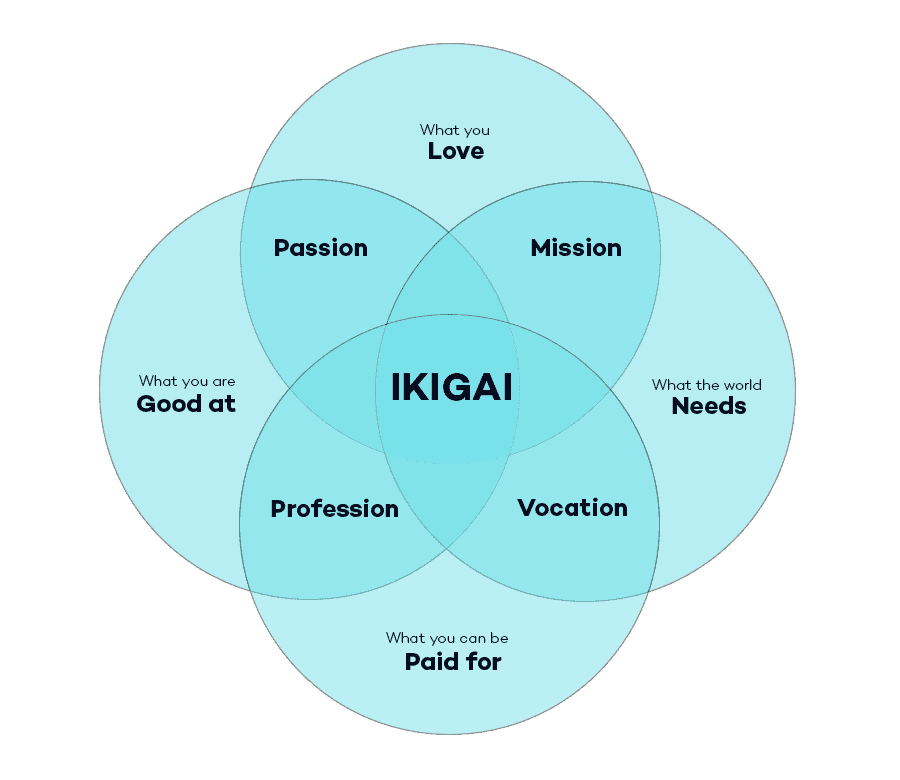
A key component of Ikigai is the ability to see the direct impact of your work. Ikigai can even increase longevity. Japanese Okinawans who embody Ikigai are known to live well past the age of 100.

Finding your Ikigai does not need to be in a grandiose way either. In fact, humans have the incredible ability to create meaning out of even the most mundane, or awful, of circumstances. In Viktor Frankl’s Man’s Search for Meaning, which he wrote after enduring the concentration camps, he explains:

‘To choose one’s attitude in any given set of circumstances, to choose one’s own way…that the sort of person the prisoner became was the result of an inner decision, and not the result of camp influences alone…It is this spiritual freedom — which cannot be taken away — that makes life meaningful and purposeful.”

Perhaps the answer is to focus less on loving the work you do and more on doing work that is meaningful.


More Like This

Thought Leadership

Beating Winter Malaise: Stay Productive During Dark Season

Game of Thrones, and its Song of Ice and Fire source material before it, connected with viewers around the globe for a variety of reasons. Arguably first among them was escapism. For an hour each week, viewers would disconnect from their lives and focus instead on this intoxicating fantasy realm, replete with magic, medieval brutality, and dragons. But even the most seemingly imaginative of otherworldly distractions requires some ties to everyday reality to land with an audience. For Games of Thrones, one such stark (and Stark) pronouncement that permeated the zeitgeist and became an everyday part of the cultural lexicon was the oft-repeated, ever-ominous assertion: Winter is coming. As clocks turn back in most of the western world, we must contend with the fact that, though we are still in the throes of autumn, winter has come, or at the very least is coming, bringing with it the annual productivity malaise that accompanies the season of darkness. Winter is the least productive season for businesses. That’s according to research from project management software company Redbooth, published in Forbes magazine1. The company analysed their data over a four-year period and found that in winter users completed 22.8% of their tasks on average, compared with 27.3% in the autumn, 25.4% in the summer and 24.5% in the spring. A report by British Summer Fruits2 found that during the colder months, 74% of people find it harder to get out of bed for work, while 37% are far more likely to call in sick. In A Christmas Carol, Charles Dickens proclaimed that, “Darkness is cheap.” Not, it seems, if you’re running a business contending with a seasonal productivity slump.

Shay Dalton

Thought Leadership

Charlie Munger: How Psychology Drives Business Success

In the world of investing, Charlie Munger is a legendary figure, celebrated for his sage-like wisdom and insightful aphorisms. As Warren Buffet’s right-hand man, his approach is a testament to the power of effective decision-making and wisdom, which he famously accredits to his ‘multi-disciplinary’ approach—a rich mosaic of insights from various academic disciplines, including applied, organisational, and social psychology. Munger’s perspective is unique and practical because he harnesses these theories and translates them into real-world applications. His approach forms an interesting amalgamation, merging business acumen with psychological theories—a powerful combination that leads to meaningful, insightful, and profitable decisions.

Shay Dalton

Thought Leadership

Beating Winter Malaise: Stay Productive During Dark Season

Game of Thrones, and its Song of Ice and Fire source material before it, connected with viewers around the globe for a variety of reasons. Arguably first among them was escapism. For an hour each week, viewers would disconnect from their lives and focus instead on this intoxicating fantasy realm, replete with magic, medieval brutality, and dragons. But even the most seemingly imaginative of otherworldly distractions requires some ties to everyday reality to land with an audience. For Games of Thrones, one such stark (and Stark) pronouncement that permeated the zeitgeist and became an everyday part of the cultural lexicon was the oft-repeated, ever-ominous assertion: Winter is coming. As clocks turn back in most of the western world, we must contend with the fact that, though we are still in the throes of autumn, winter has come, or at the very least is coming, bringing with it the annual productivity malaise that accompanies the season of darkness. Winter is the least productive season for businesses. That’s according to research from project management software company Redbooth, published in Forbes magazine1. The company analysed their data over a four-year period and found that in winter users completed 22.8% of their tasks on average, compared with 27.3% in the autumn, 25.4% in the summer and 24.5% in the spring. A report by British Summer Fruits2 found that during the colder months, 74% of people find it harder to get out of bed for work, while 37% are far more likely to call in sick. In A Christmas Carol, Charles Dickens proclaimed that, “Darkness is cheap.” Not, it seems, if you’re running a business contending with a seasonal productivity slump.

Shay Dalton

Thought Leadership

Combatting Decision Fatigue

What milk do you want with your coffee? Which song of the millions at your fingertips do you want to start your day? Which of that growing stack of emails are you going to answer first? Choose this. Now that. Are you sure? And again. Choices, choices, decisions, decisions, all day, every day – and aren’t you feeling tired? By some estimates, adults today make 2,000 decisions an hour [1]. By others, 35,000 decisions a day [2]. Either way, it’s an overload. And it’s causing decision fatigue.

Shay Dalton

Thought Leadership

Charlie Munger: How Psychology Drives Business Success

In the world of investing, Charlie Munger is a legendary figure, celebrated for his sage-like wisdom and insightful aphorisms. As Warren Buffet’s right-hand man, his approach is a testament to the power of effective decision-making and wisdom, which he famously accredits to his ‘multi-disciplinary’ approach—a rich mosaic of insights from various academic disciplines, including applied, organisational, and social psychology. Munger’s perspective is unique and practical because he harnesses these theories and translates them into real-world applications. His approach forms an interesting amalgamation, merging business acumen with psychological theories—a powerful combination that leads to meaningful, insightful, and profitable decisions.

Shay Dalton

Thought Leadership

Beating Winter Malaise: Stay Productive During Dark Season

Game of Thrones, and its Song of Ice and Fire source material before it, connected with viewers around the globe for a variety of reasons. Arguably first among them was escapism. For an hour each week, viewers would disconnect from their lives and focus instead on this intoxicating fantasy realm, replete with magic, medieval brutality, and dragons. But even the most seemingly imaginative of otherworldly distractions requires some ties to everyday reality to land with an audience. For Games of Thrones, one such stark (and Stark) pronouncement that permeated the zeitgeist and became an everyday part of the cultural lexicon was the oft-repeated, ever-ominous assertion: Winter is coming. As clocks turn back in most of the western world, we must contend with the fact that, though we are still in the throes of autumn, winter has come, or at the very least is coming, bringing with it the annual productivity malaise that accompanies the season of darkness. Winter is the least productive season for businesses. That’s according to research from project management software company Redbooth, published in Forbes magazine1. The company analysed their data over a four-year period and found that in winter users completed 22.8% of their tasks on average, compared with 27.3% in the autumn, 25.4% in the summer and 24.5% in the spring. A report by British Summer Fruits2 found that during the colder months, 74% of people find it harder to get out of bed for work, while 37% are far more likely to call in sick. In A Christmas Carol, Charles Dickens proclaimed that, “Darkness is cheap.” Not, it seems, if you’re running a business contending with a seasonal productivity slump.

Shay Dalton

Thought Leadership

Combatting Decision Fatigue

What milk do you want with your coffee? Which song of the millions at your fingertips do you want to start your day? Which of that growing stack of emails are you going to answer first? Choose this. Now that. Are you sure? And again. Choices, choices, decisions, decisions, all day, every day – and aren’t you feeling tired? By some estimates, adults today make 2,000 decisions an hour [1]. By others, 35,000 decisions a day [2]. Either way, it’s an overload. And it’s causing decision fatigue.

Shay Dalton

Thought Leadership

Charlie Munger: How Psychology Drives Business Success

In the world of investing, Charlie Munger is a legendary figure, celebrated for his sage-like wisdom and insightful aphorisms. As Warren Buffet’s right-hand man, his approach is a testament to the power of effective decision-making and wisdom, which he famously accredits to his ‘multi-disciplinary’ approach—a rich mosaic of insights from various academic disciplines, including applied, organisational, and social psychology. Munger’s perspective is unique and practical because he harnesses these theories and translates them into real-world applications. His approach forms an interesting amalgamation, merging business acumen with psychological theories—a powerful combination that leads to meaningful, insightful, and profitable decisions.

Shay Dalton

Stay Ahead Every Sunday

Every Sunday we compile a digest of the weekend’s business news including the main talking points and highlights from

For information about our privacy practices and commitment to protecting your privacy, check out our Privacy Policy.

Stay Ahead Every Sunday

Every Sunday we compile a digest of the weekend’s business news including the main talking points and highlights from

For information about our privacy practices and commitment to protecting your privacy, check out our Privacy Policy.

Stay Ahead Every Sunday

Every Sunday we compile a digest of the weekend’s business news including the main talking points and highlights from

For information about our privacy practices and commitment to protecting your privacy, check out our Privacy Policy.