
Thought Leadership

Cultivating Quality Relationships through LMX

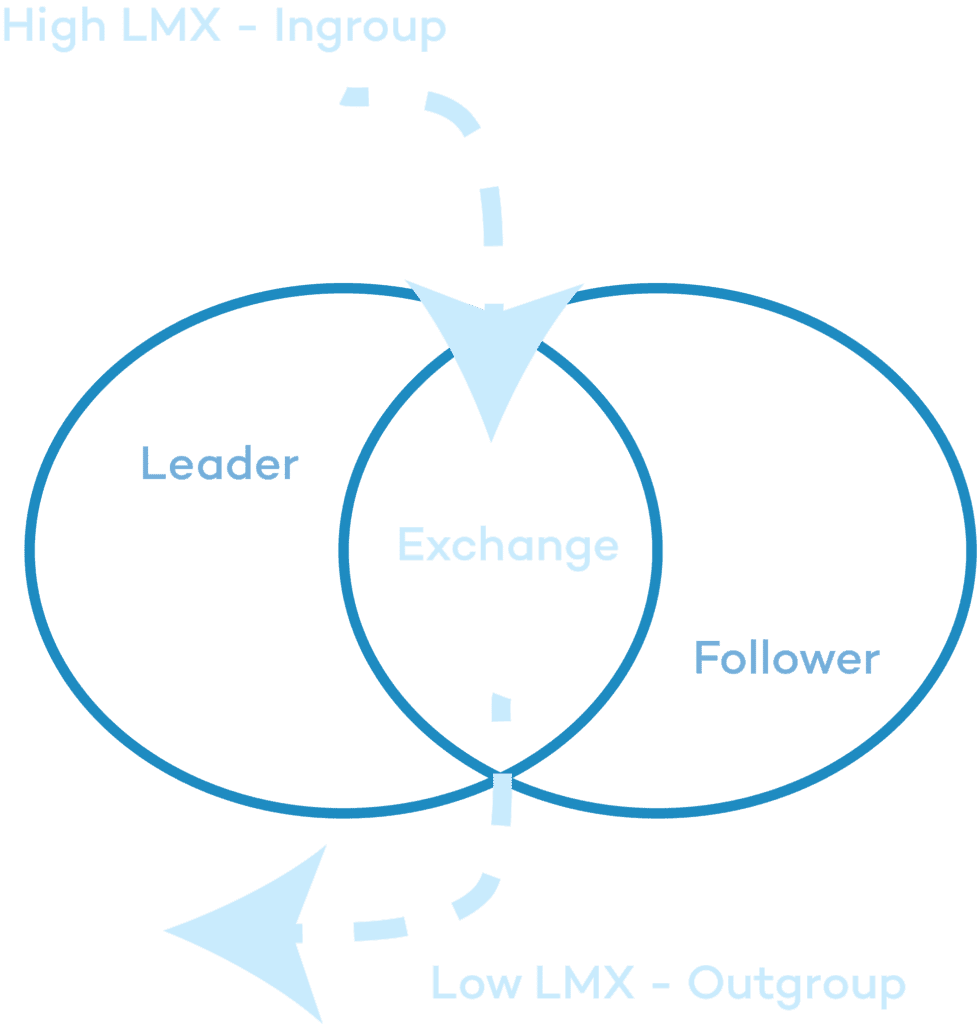
Leader Member Exchange (LMX) is a theory which focuses on the quality of the relationship between superior (leader) and subordinate (employee). The theory supports an ingroup, midgroup and outgroup (Horan et al., 2013). Employees within the ingroup may experience higher levels of LMX which is linked to increased confidence and positive relations; whilst outgroup interactions are characterised by low trust and minimal support (Horan et al., 2013).

Outgroups V Ingroups

In circumstances where employees do not develop a positive reciprocal relationship with their leader, they are said to belong to the outgroup. The outgroup refers to subordinates who are subjected to negative reinforcements from the leader and do not benefit from a rich relationship with their leader (Farr-Wharton et al., 2018). Due to the leaders’ time constraints, these relationships quickly form and range in quality from lower to higher exchanges (Deluga, 1998). 

Leaders typically use their formal authority within organisations to communicate and instill shared values among their employees (Deluga.,1998). In exchange, employees work hard to fulfill the criteria of their clearly specified roles. There are several interpersonal factors present in these dealings, including mutual trust, loyalty, and close communication (Deluga.,1998).


Influence of High LMX on Employee Motivation

According to Farr-Wharton, Brunetto, and Shacklock (2012), the ideal situation with LMX is for employees to have high quality relationships, which will then yield the greatest benefits for both parties. LMX requires a perception of trustworthiness from the employee based on their leader in order for a high quality relationship to be facilitated (Chen et al.,2012). Emphasising the significance of superior LMX is crucial for leaders, as it has been associated with enhanced levels of competence and autonomy, consequently fostering heightened intrinsic motivation (Xie et al., 2020). 

In relation to the LMX model, leaders should make use of a framework of social exchange in which connections are built with employees and knowledge is shared (Kim et al., 2017). Trust & social exchanges which occur as a result of high LMX can provide the leader with an insight into the employees thought processes with regard to their level of  knowledge (Whisnant and Khasawneh, 2014). This can also help leaders navigate the areas in which employees require further support and guidance. From a leadership standpoint this is a valuable perspective as it identifies areas where employees require support which in turn fosters increased motivation and a sense of value within the organisation.

More on Trust & Autonomy

The Importance of Trust

Why You Should Delegate – And How To Do It Effectively

Leadership in Focus: Foundations and the Path Forward

10 Traits of a Great Leader

More Like This

Thought Leadership

Beating Winter Malaise: Stay Productive During Dark Season

Game of Thrones, and its Song of Ice and Fire source material before it, connected with viewers around the globe for a variety of reasons. Arguably first among them was escapism. For an hour each week, viewers would disconnect from their lives and focus instead on this intoxicating fantasy realm, replete with magic, medieval brutality, and dragons. But even the most seemingly imaginative of otherworldly distractions requires some ties to everyday reality to land with an audience. For Games of Thrones, one such stark (and Stark) pronouncement that permeated the zeitgeist and became an everyday part of the cultural lexicon was the oft-repeated, ever-ominous assertion: Winter is coming. As clocks turn back in most of the western world, we must contend with the fact that, though we are still in the throes of autumn, winter has come, or at the very least is coming, bringing with it the annual productivity malaise that accompanies the season of darkness. Winter is the least productive season for businesses. That’s according to research from project management software company Redbooth, published in Forbes magazine1. The company analysed their data over a four-year period and found that in winter users completed 22.8% of their tasks on average, compared with 27.3% in the autumn, 25.4% in the summer and 24.5% in the spring. A report by British Summer Fruits2 found that during the colder months, 74% of people find it harder to get out of bed for work, while 37% are far more likely to call in sick. In A Christmas Carol, Charles Dickens proclaimed that, “Darkness is cheap.” Not, it seems, if you’re running a business contending with a seasonal productivity slump.

Shay Dalton

Thought Leadership

Charlie Munger: How Psychology Drives Business Success

In the world of investing, Charlie Munger is a legendary figure, celebrated for his sage-like wisdom and insightful aphorisms. As Warren Buffet’s right-hand man, his approach is a testament to the power of effective decision-making and wisdom, which he famously accredits to his ‘multi-disciplinary’ approach—a rich mosaic of insights from various academic disciplines, including applied, organisational, and social psychology. Munger’s perspective is unique and practical because he harnesses these theories and translates them into real-world applications. His approach forms an interesting amalgamation, merging business acumen with psychological theories—a powerful combination that leads to meaningful, insightful, and profitable decisions.

Shay Dalton

Thought Leadership

Beating Winter Malaise: Stay Productive During Dark Season

Game of Thrones, and its Song of Ice and Fire source material before it, connected with viewers around the globe for a variety of reasons. Arguably first among them was escapism. For an hour each week, viewers would disconnect from their lives and focus instead on this intoxicating fantasy realm, replete with magic, medieval brutality, and dragons. But even the most seemingly imaginative of otherworldly distractions requires some ties to everyday reality to land with an audience. For Games of Thrones, one such stark (and Stark) pronouncement that permeated the zeitgeist and became an everyday part of the cultural lexicon was the oft-repeated, ever-ominous assertion: Winter is coming. As clocks turn back in most of the western world, we must contend with the fact that, though we are still in the throes of autumn, winter has come, or at the very least is coming, bringing with it the annual productivity malaise that accompanies the season of darkness. Winter is the least productive season for businesses. That’s according to research from project management software company Redbooth, published in Forbes magazine1. The company analysed their data over a four-year period and found that in winter users completed 22.8% of their tasks on average, compared with 27.3% in the autumn, 25.4% in the summer and 24.5% in the spring. A report by British Summer Fruits2 found that during the colder months, 74% of people find it harder to get out of bed for work, while 37% are far more likely to call in sick. In A Christmas Carol, Charles Dickens proclaimed that, “Darkness is cheap.” Not, it seems, if you’re running a business contending with a seasonal productivity slump.

Shay Dalton

Thought Leadership

Combatting Decision Fatigue

What milk do you want with your coffee? Which song of the millions at your fingertips do you want to start your day? Which of that growing stack of emails are you going to answer first? Choose this. Now that. Are you sure? And again. Choices, choices, decisions, decisions, all day, every day – and aren’t you feeling tired? By some estimates, adults today make 2,000 decisions an hour [1]. By others, 35,000 decisions a day [2]. Either way, it’s an overload. And it’s causing decision fatigue.

Shay Dalton

Thought Leadership

Charlie Munger: How Psychology Drives Business Success

In the world of investing, Charlie Munger is a legendary figure, celebrated for his sage-like wisdom and insightful aphorisms. As Warren Buffet’s right-hand man, his approach is a testament to the power of effective decision-making and wisdom, which he famously accredits to his ‘multi-disciplinary’ approach—a rich mosaic of insights from various academic disciplines, including applied, organisational, and social psychology. Munger’s perspective is unique and practical because he harnesses these theories and translates them into real-world applications. His approach forms an interesting amalgamation, merging business acumen with psychological theories—a powerful combination that leads to meaningful, insightful, and profitable decisions.

Shay Dalton

Thought Leadership

Beating Winter Malaise: Stay Productive During Dark Season

Game of Thrones, and its Song of Ice and Fire source material before it, connected with viewers around the globe for a variety of reasons. Arguably first among them was escapism. For an hour each week, viewers would disconnect from their lives and focus instead on this intoxicating fantasy realm, replete with magic, medieval brutality, and dragons. But even the most seemingly imaginative of otherworldly distractions requires some ties to everyday reality to land with an audience. For Games of Thrones, one such stark (and Stark) pronouncement that permeated the zeitgeist and became an everyday part of the cultural lexicon was the oft-repeated, ever-ominous assertion: Winter is coming. As clocks turn back in most of the western world, we must contend with the fact that, though we are still in the throes of autumn, winter has come, or at the very least is coming, bringing with it the annual productivity malaise that accompanies the season of darkness. Winter is the least productive season for businesses. That’s according to research from project management software company Redbooth, published in Forbes magazine1. The company analysed their data over a four-year period and found that in winter users completed 22.8% of their tasks on average, compared with 27.3% in the autumn, 25.4% in the summer and 24.5% in the spring. A report by British Summer Fruits2 found that during the colder months, 74% of people find it harder to get out of bed for work, while 37% are far more likely to call in sick. In A Christmas Carol, Charles Dickens proclaimed that, “Darkness is cheap.” Not, it seems, if you’re running a business contending with a seasonal productivity slump.

Shay Dalton

Thought Leadership

Combatting Decision Fatigue

What milk do you want with your coffee? Which song of the millions at your fingertips do you want to start your day? Which of that growing stack of emails are you going to answer first? Choose this. Now that. Are you sure? And again. Choices, choices, decisions, decisions, all day, every day – and aren’t you feeling tired? By some estimates, adults today make 2,000 decisions an hour [1]. By others, 35,000 decisions a day [2]. Either way, it’s an overload. And it’s causing decision fatigue.

Shay Dalton

Thought Leadership

Charlie Munger: How Psychology Drives Business Success

In the world of investing, Charlie Munger is a legendary figure, celebrated for his sage-like wisdom and insightful aphorisms. As Warren Buffet’s right-hand man, his approach is a testament to the power of effective decision-making and wisdom, which he famously accredits to his ‘multi-disciplinary’ approach—a rich mosaic of insights from various academic disciplines, including applied, organisational, and social psychology. Munger’s perspective is unique and practical because he harnesses these theories and translates them into real-world applications. His approach forms an interesting amalgamation, merging business acumen with psychological theories—a powerful combination that leads to meaningful, insightful, and profitable decisions.

Shay Dalton

Stay Ahead Every Sunday

Every Sunday we compile a digest of the weekend’s business news including the main talking points and highlights from

For information about our privacy practices and commitment to protecting your privacy, check out our Privacy Policy.

Stay Ahead Every Sunday

Every Sunday we compile a digest of the weekend’s business news including the main talking points and highlights from

For information about our privacy practices and commitment to protecting your privacy, check out our Privacy Policy.

Stay Ahead Every Sunday

Every Sunday we compile a digest of the weekend’s business news including the main talking points and highlights from

For information about our privacy practices and commitment to protecting your privacy, check out our Privacy Policy.